Working With the Grain: Taoist Philosophy for the Solo Entrepreneur
Solo entrepreneurship seems to contradict everything Taoism teaches. Taoism says yield; the founder is told to hustle. Taoism praises the person who acts without straining; the founder grades the day by how much effort it cost.
But a philosophy built on water, emptiness, and not forcing things has more to offer someone building alone than most productivity systems do. Here's why: it correctly diagnoses what actually breaks solo founders. It isn't laziness. It's grinding effort in the wrong direction for too long.
Wu wei isn't doing nothing
Wu wei is the most quoted and most misread idea in Taoism. People translate it as "non-action" or "effortless action," then flatten it into "don't force it, go with the flow." If you have to write the code, answer every email, and close every deal yourself, that advice sounds either impossible or like an excuse to slack off.
Wu wei was never about doing less. The Zhuangzi's best picture of it is a butcher whose knife has stayed sharp for nineteen years because he never cuts through bone. He finds the gap in the joint and slides the blade through the space that's already there. His work looks easy, not because he avoids it, but because he stopped fighting the meat.
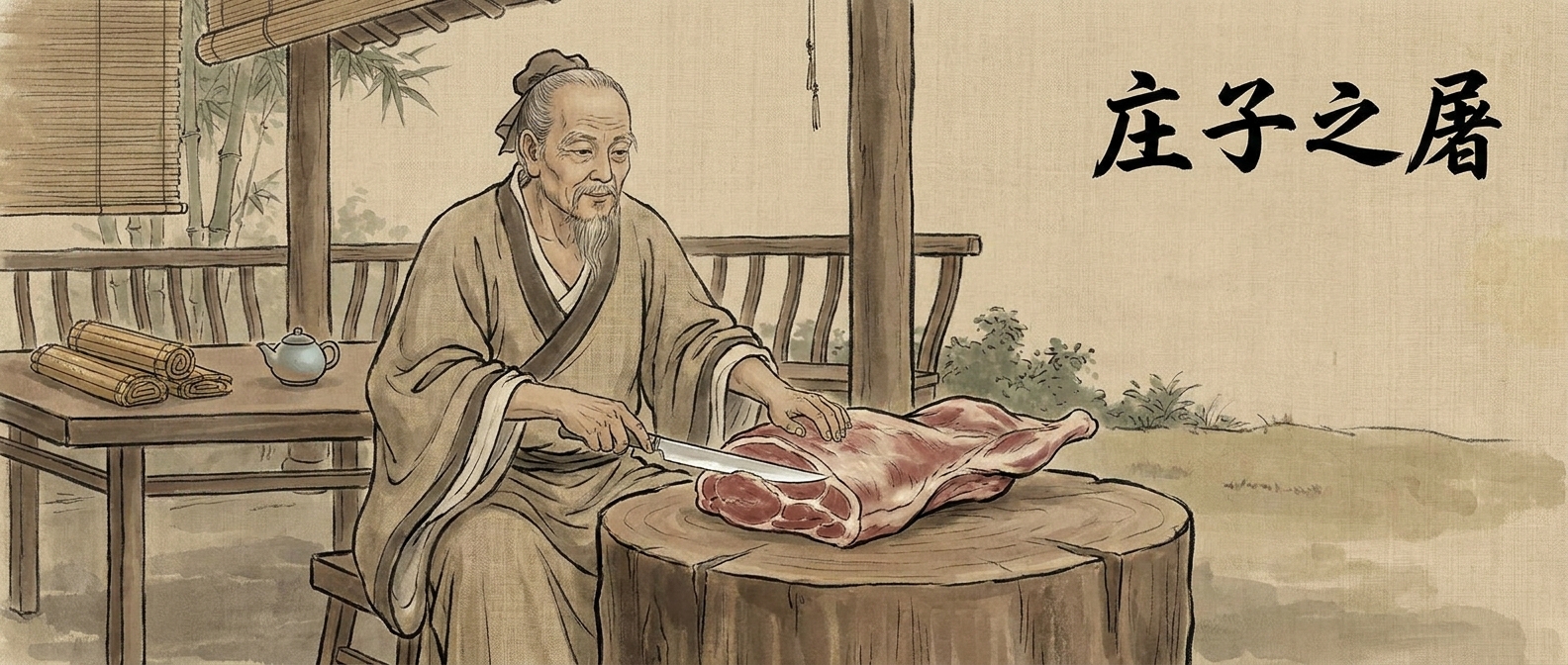
For a solo founder, that's a skill of reading resistance, not permission to coast. Every day pushes back. Some of that resistance is a joint — a seam you can slip through if you find the right angle. Some of it is bone: a market that isn't ready, a customer who's never going to buy, a feature your product keeps rejecting. The founder who burns out usually isn't the one who worked too little. It's the one who spent six months hammering the blade into bone and called it grit.
No one's watching, and that helps
Working alone removes one of the most seductive lies in work: that visible struggle means you're doing it right. On a team, some of your effort is performance. You grind partly because people are watching, and looking busy protects your standing. Alone, nobody's watching. There's no one to impress with how hard you're suffering.
That's exactly the condition Taoists valued. The butcher earns respect because his work looks easy. The sage finishes the job and moves on without asking for credit. The solo founder gets a rare option: optimize for the clean cut instead of the appearance of hard work. You can stop asking "am I working hard enough" and start asking "am I working where the work actually gives." Most people never find out what they'd do if no one were keeping score.
Let it become what it is
Ziran means "self-so," or naturalness: things doing well by growing into their own shape instead of one forced on them from outside. The standard startup story runs the other way. Pick the biggest market you can name, then drag the company toward it. But businesses that find real traction often do the opposite. They start somewhere small and true, and let the thing show them what it wants to be.
There's a real trap here, and I'd rather name it than pretend it isn't there. "I'm letting it unfold naturally" is also the perfect cover for "I'm scared to make the hard call." Ziran isn't drifting. The texts won't hand you a clean test for telling patient following apart from cowardly avoidance. Figuring out which one you're doing is the actual work, and you can't hand it off to a principle.
Water, and the low spot
"The highest good is like water," says the Tao Te Ching. Water helps everything and fights nothing. It seeks the low places people look down on, and that's what brings it close to the Tao. This isn't only poetry. Water wins by yielding: it goes around the rock, and given enough time, the rock is gone.
If you're selling, partnering, fundraising, or hiring alone, taking the low spot isn't weakness. A founder who walks in needing to be the smartest person in the room pushes people away. The one who walks in genuinely curious, asking the real question, pulls them in. The valley collects the streams because it sits below them.
Rhythm, and the uncarved block
You have one body and a fixed amount of energy. The Taoist feel for yin and yang is, in practice, a feel for rhythm: when to push and when to ease off, when to work and when to lie fallow. Forcing output while you're running on empty is, again, cutting against the grain. Rest isn't the absence of work. It's the half of the cycle that makes the work possible.
Then there's pu, the uncarved block — the worth of raw, unshaped potential. Taoism has a strange respect for the useless. In the Zhuangzi, a huge tree survives precisely because its wood is no good for lumber, so nobody cuts it down. A solo founder is always tempted to carve every hour into something productive. But the apparently useless parts of a life, the walk, the hobby, the game you play for no reason, are often what keep you whole enough to make anything at all. Leave some of the block uncut.
The actual practice
None of this turns into a rulebook, and that's the point. "The Tao that can be spoken is not the eternal Tao." What Taoism gives a solo founder isn't a system. It's a sharper sense: for the grain of things, for the gap between effort that slips through the joint and effort that grinds on bone, for when to push and when to yield, for the quiet that working alone makes possible.