PAIGE Development Update — From AI Research to a Working Coding Assistant
On October 29, I shared the architecture of PAIGE, my private AI research project, and the idea of developing personally controlled AI rather than depending entirely on commercial cloud services.
At that time, PAIGE was at v13.0, and its next milestone was still in planning.
Today, November 25, PAIGE has reached another development milestone.
PAIGE v14.0 is now official, and the project has progressed beyond its original experimental foundation into practical, deterministic Python coding assistance.
What's been accomplished since the previous update:
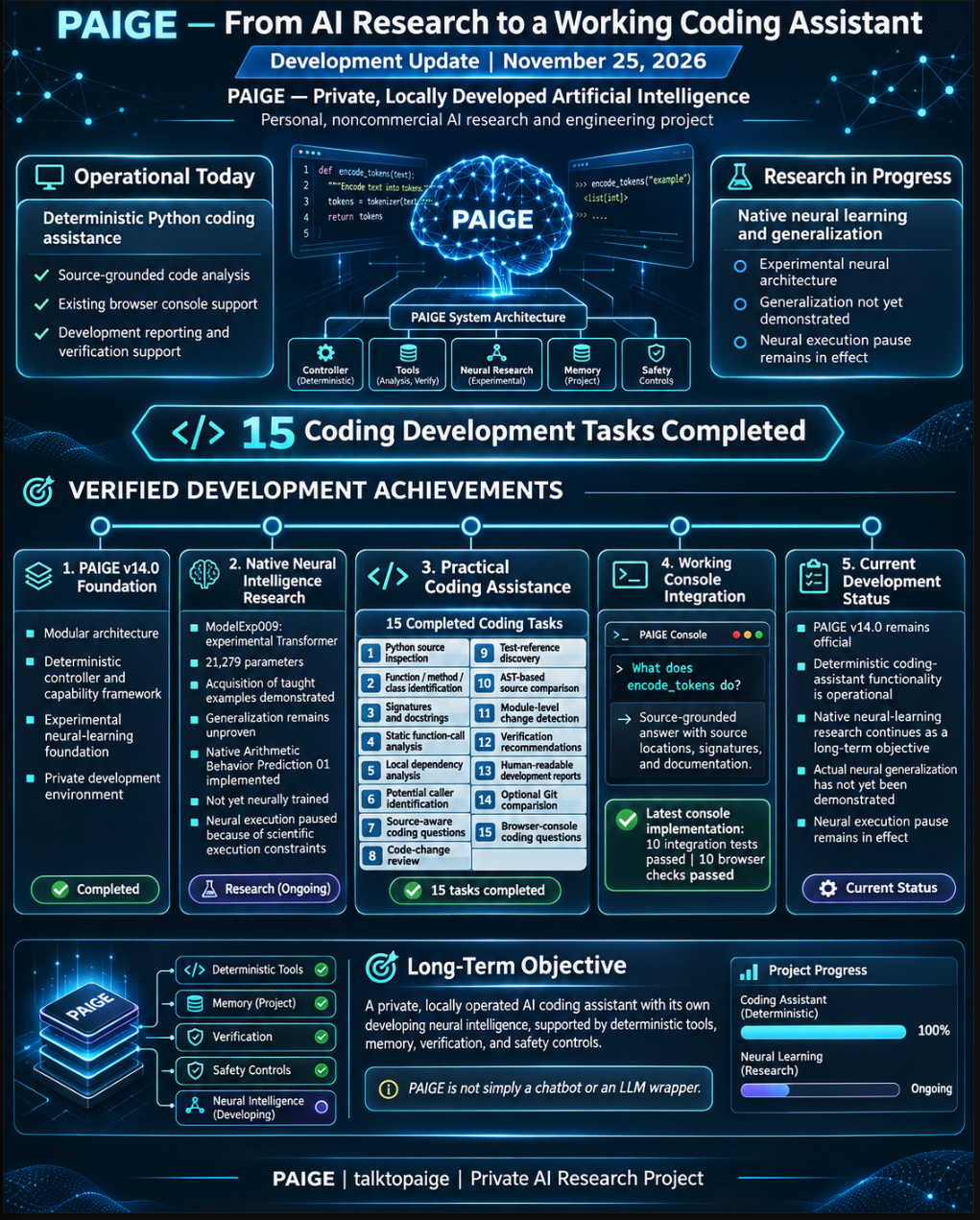
Completed 15 incremental coding development tasks.
Implemented source-aware Python code inspection and analysis.
Added function and dependency analysis, code-change reviews, and test-reference discovery.
Integrated coding assistance into PAIGE's existing browser console.
Passed 10 integration tests and 10 browser checks in the latest console implementation.
PAIGE can now help answer questions about Python source code, identify relationships between functions, and provide source-grounded information to support development decisions.
An important distinction:
These are working deterministic capabilities, not evidence that PAIGE has achieved independent neural reasoning.
Its native neural intelligence remains experimental. Learned generalization has not yet been demonstrated, and neural execution remains paused.
My long-term objective hasn't changed: to build a private, locally operated AI coding assistant that I can understand, control, and gradually improve on my own hardware.
The accompanying infographic illustrates what's operational today, what remains experimental, and the direction of future development.
The philosophy behind PAIGE remains simple:
Start small. Learn deeply. Build carefully.
One capability at a time.
#PAIGE #LocalAI #PersonalAI #SoftwareEngineering